This presentation is intended to remain in full screen during playback so the visuals, narration timing, and slide changes stay readable.
ANALYSIS OF A NORTHWEST ARKANSAS PREMIUM ESTATE PROPERTY · CUSTOMER INTERACTIVE PRESENTATION · APPROX. 8–10 MINUTES
This drainage proposal for a Northwest Arkansas Premium Estate was evaluated as a roof-runoff and site-water-management issue, not simply as a pipe-installation exercise. The work required an understanding of how rainfall reaches the home, how runoff accumulates, how gravity routing behaves across the property, and how to reduce the risk of expensive hidden failure after the trench is closed.
This slide establishes the real rainfall burden first. Before any installation discussion, the homeowner should understand that this project was checked against meaningful storm depth in the same units people actually remember: inches of rain.
0.734 inches in 5 minutes, 2.76 inches in 60 minutes, and 6.29 inches in 24 hours from NOAA Atlas 14 for the Fayetteville / Lowell reference point. Those correspond to about 8.81 in/hr, 2.76 in/hr, and 0.262 in/hr average intensity, and across the 9,384.9 ft² pitch-adjusted roof model they translate to about 858.8 GPM / 1.913 CFS, 269.0 GPM / 0.599 CFS, and 25.6 GPM / 0.057 CFS average, respectively.
Public station data recorded 3.07 inches in 1 hour — about 11.2% above the project’s 1-hour benchmark of 2.76 inches. On the full 9,384.9 ft² pitch-adjusted roof model, that hourly burden would equate to about 299.3 GPM or 0.667 CFS, with about 17,960.5 gallons or 2,401.0 cubic feet over the hour.
Public station data recorded 2.05 inches in 1 hour, or about 74.3% of the project’s 1-hour benchmark. Even then, NOAA still logged flash flooding. On the full 9,384.9 ft² pitch-adjusted roof model, that hourly burden would still equate to about 199.9 GPM or 0.445 CFS, with about 11,993.2 gallons or 1,603.3 cubic feet over the hour.
Public daily data recorded 6.49 inches in 24 hours, about 3.2% above the project’s 24-hour benchmark of 6.29 inches. Averaged over the day, that is about 0.270 in/hr; on the full 9,384.9 ft² pitch-adjusted roof model, it corresponds to about 26.4 GPM or 0.059 CFS average, totaling about 37,968.6 gallons or 5,075.7 cubic feet.
The official event narrative states that four to five inches of rain fell, with most of it occurring between midnight and 4:30 a.m. — exactly how a homeowner remembers a storm. If averaged across that reported 4.5-hour window, that is about 0.889 to 1.111 in/hr, or roughly 86.7 to 108.3 GPM / 0.193 to 0.241 CFS across the full pitch-adjusted roof model.
On Downspout #8’s 1,200.5 ft² pitch-adjusted roof area, 4.0 inches equals about 2,993.5 gallons or 400.2 cubic feet, and 5.0 inches equals about 3,741.8 gallons or 500.2 cubic feet. If those totals are averaged over the reported 4.5-hour event window, that is roughly 11.1 to 13.9 GPM or 0.025 to 0.031 CFS at that one downspout catchment. Across the entire pitch-adjusted modeled roof area, that same storm depth corresponds to about 23,401.3 to 29,251.6 gallons, or about 3,128.3 to 3,910.4 cubic feet; spread across 4.5 hours, that averages about 86.7 to 108.3 GPM or 0.193 to 0.241 CFS.
These observed events ground the rest of the presentation in real storm depth, real property risk, and real homeowner consequences.
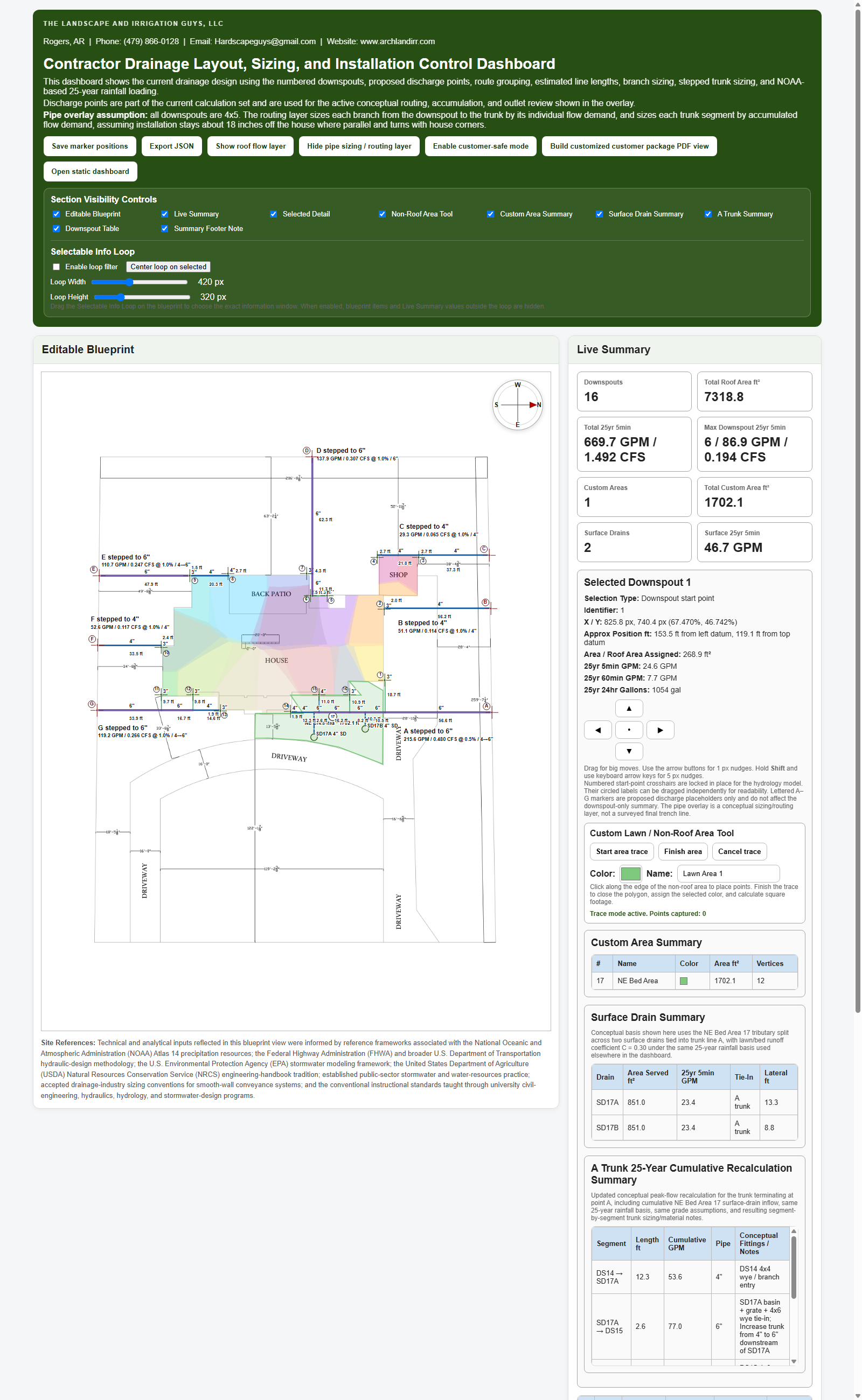
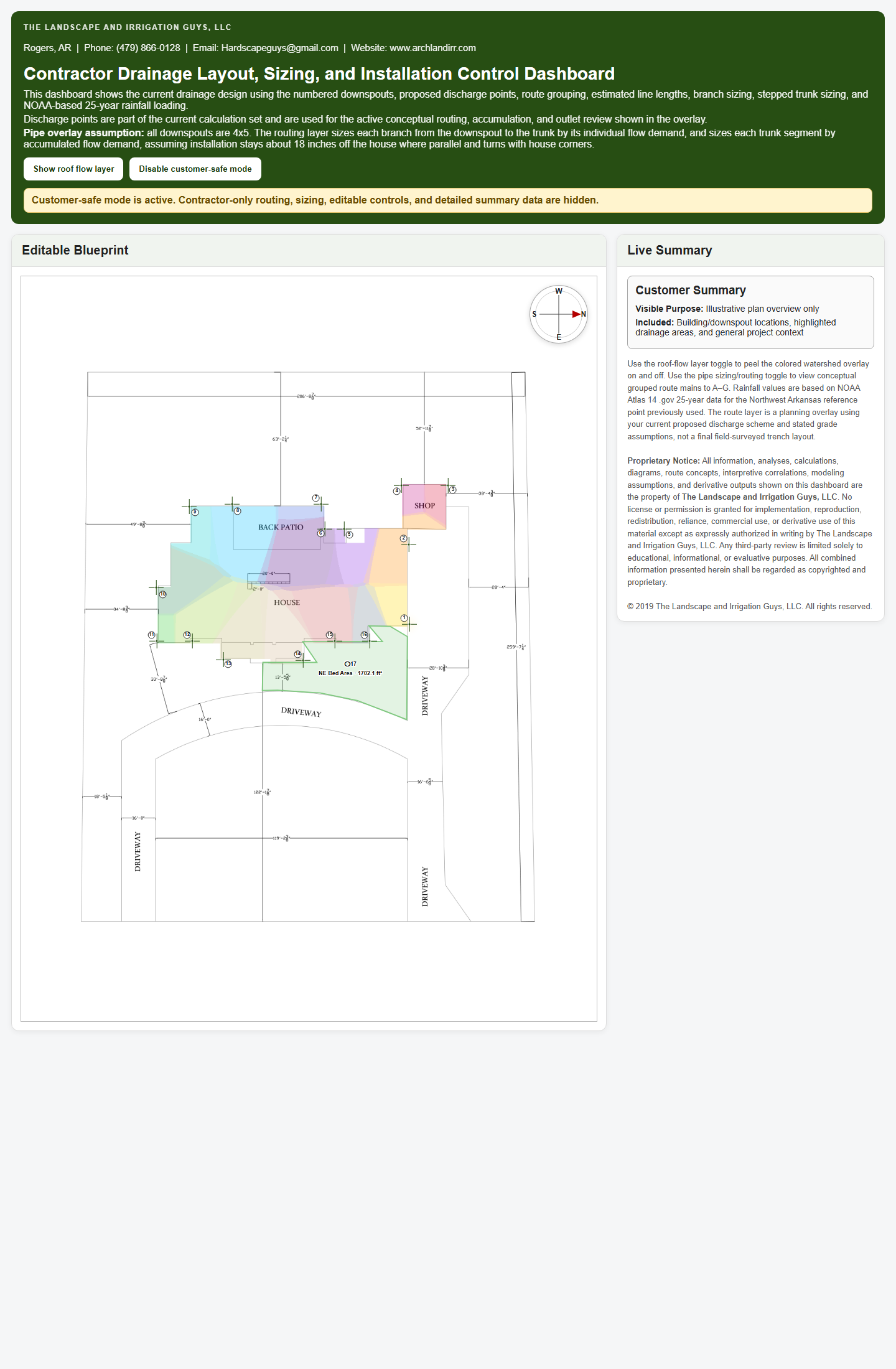
The drainage system does not experience “roof water” in the abstract. It experiences runoff arriving at specific entry points, from specific contributing roof areas and roof slopes, over specific storm durations. Tributary-area interpretation matters because different portions of the home create different burdens, and those burdens accumulate differently once they combine underground.

| Downspout | Roof Area ft² | 5-Min Storm | 1-Hour Storm | 24-Hour Storm |
|---|---|---|---|---|
| DS08 | 1200.5 | 0.734 in in 5 min 109.9 GPM / 0.245 CFS ≈ 549.3 gal / 73.4 cu ft | 2.76 in in 60 min 34.4 GPM avg / 0.077 CFS ≈ 2,065.5 gal / 276.1 cu ft | 6.29 in in 24 hr 4,707 gal / 629.3 cu ft 3.27 GPM avg / 0.007 CFS |
Step 1: identify the contributing roof area associated with each collection point.
Step 2: apply local rainfall depth in inches over the relevant storm duration, then convert that depth to intensity, volume, and flow-rate equivalents as needed.
Step 3: convert plan-view catchment to estimated sloped roof area where pitch differs, then translate those inches into practical water burden for comparison, grouping, and pipe checking in gallons, cubic feet, GPM, and CFS.
Runoff assumption used: roof coefficient = 1.00, applied to pitch-adjusted roof area by roof section.
Slope % = fall ÷ run × 100
Required fall was checked against route length and geometry.
Pipe capacity was evaluated behind the scenes so the recommendation would be technically defensible, not merely visually tidy.
Manning roughness used: n = 0.009 for smooth-wall sewer-and-drain assumptions.
| System | Grade % | Connected Roof Area ft² | 0.734 in / 5 min | 5-min Flow | 6.29 in / 24 hr | Farthest Fall In |
|---|---|---|---|---|---|---|
| System 1 | 1.0 | 337.4 | 154.4 gal 20.6 cu ft | 30.8 GPM 0.069 CFS | 1323.0 gal 176.9 cu ft · 0.92 GPM avg / 0.002 CFS | 7.42 |
| System 2 | 1.0 | 671.7 | 307.3 gal 41.1 cu ft | 61.5 GPM 0.137 CFS | 2634.0 gal 352.1 cu ft · 1.83 GPM avg / 0.004 CFS | 6.98 |
| System 3 | 1.0 | 690.6 | 316.0 gal 42.2 cu ft | 63.2 GPM 0.141 CFS | 2708.0 gal 362.0 cu ft · 1.88 GPM avg / 0.004 CFS | 4.31 |
| System 4 | 1.0 | 1460.4 | 668.2 gal 89.3 cu ft | 133.6 GPM 0.298 CFS | 5726.0 gal 765.5 cu ft · 3.98 GPM avg / 0.009 CFS | 8.05 |
| System 5 | 1.0 | 1546.1 | 707.4 gal 94.6 cu ft | 141.5 GPM 0.315 CFS | 6062.0 gal 810.4 cu ft · 4.21 GPM avg / 0.009 CFS | 8.51 |
| System 6 | 1.0 | 2067.9 | 946.2 gal 126.5 cu ft | 189.3 GPM 0.422 CFS | 8109.0 gal 1084.1 cu ft · 5.63 GPM avg / 0.013 CFS | 10.00 |
| System 7 | 0.5 | 2610.8 | 1194.6 gal 159.7 cu ft | 238.9 GPM 0.532 CFS | 10237.0 gal 1368.6 cu ft · 7.11 GPM avg / 0.016 CFS | 6.50 |
| Example System | Connected Roof Area ft² | 5-min Flow @ 0.734 in | 24-hr burden @ 6.29 in | Planning Interpretation |
|---|---|---|---|---|
| Light Example | 337.4 | 30.8 GPM / 0.069 CFS | 1323.0 gal / 176.9 cu ft 0.92 GPM avg / 0.002 CFS | Lighter route burden |
| Moderate Example | 671.7 | 61.5 GPM / 0.137 CFS | 2634.0 gal / 352.1 cu ft 1.83 GPM avg / 0.004 CFS | Moderate single-point burden |
| Heavy Example | 1546.1 | 141.5 GPM / 0.315 CFS | 6062.0 gal / 810.4 cu ft 4.21 GPM avg / 0.009 CFS | Heavy combined route burden |
| Very Heavy Example | 2610.8 | 238.9 GPM / 0.532 CFS | 10237.0 gal / 1368.6 cu ft 7.11 GPM avg / 0.016 CFS | Very heavy trunk burden |
A drainage system can be conceptually sound and still fail in the field if grade is not held, crossings are misplaced, trench elevations drift, or backfill discipline is poor. Underground work is unforgiving because many installation errors remain invisible until the next major storm.
| Scenario | Estimated Man-Hours | 3-Person Crew Days | Meaning |
|---|---|---|---|
| Best-case favorable production | 140.4 | 5.9 | Possible if conditions stay unusually favorable |
| Likely planning basis | 166.7 | 6.9 | Most realistic homeowner expectation |
| Still-sane contingency | 200.5 | 8.4 | Reasonable if field friction develops |
Most drainage failures do not announce themselves on day one. They reveal themselves later, usually under meaningful rainfall, after the trench is closed and correction becomes much more expensive.
This project was evaluated through rainfall review, roof catchment analysis, grouped system logic, gravity feasibility, constructability review, and realistic execution planning. The goal was not to make the project appear complicated. The goal was to make the buried system more defensible, more reliable, and less vulnerable to preventable error.
The homeowner should expect a drainage solution that is not only installed neatly, but also thought through before the first trench is ever cut.
Goal: protect the structure, reduce water risk, and avoid paying twice for buried mistakes.